Pathfinder Uniform
The uniform makes the organisation real and visible. It represents an ideal and a standard. One of the ways to set up a standard and bring the members of an organization up to that standard is through the uniform. It should stimulate loyalty toward that standard by building morale and binding members into closer fellowship. It also appeals to those not already members to join. The uniform strengthens club spirit.
The uniform should always be clean and neat. Wearing one that fits properly will go a long way to make it look sharp. The uniform should be worn with “humble pride.” We should remember that it acts as a visual announcement of Pathfinder ministry, and should draw questions from
observers concerning the meaning of each patch and symbol.
Uniforms Do's and Don'ts
Uniform Should Be Worn
It is recommended that those having uniforms wear them on the following occasions.
- At Pathfinder meetings
- At special programs (e.g., Pathfinder Day, Induction, Investiture, etc.)
- At any public gathering when any or all act as
- Messengers
- Ushers
- Guards of honour
- First-aid details
- Colour guards
- On occasions as specified by Pathfinder staff
- While engaging in missionary outreach activities, such as Ingathering, distributing food baskets, gifts, literature, or church announcements, and while visiting nursing homes, shut-ins and community organisations.
Uniform Should Not be Worn
- If not a member
- For work or play
- When engaged in selling for personal profit, in selling for commercial or political purposes, or in personal solicitation
- At any time or place when its wearing discounts the organisation, or casts any reflection upon the uniform, lowers its dignity and esteem, and makes it commonplace
NAD Class A Uniform Standards
Each division is authorised to establish uniform standards for their division based on the guidelines provide by the General Conference. Policy prohibits unauthorized changes to logos and insignia without expressed written permission. This generally does not include limits on translation of
words or acronyms, or the modification of logos into three dimensional representations etc.
Shirt/Blouse
- Tan short sleeve shirt with two pleated patch pockets with flaps on the chest and shoulder epaulets.
Skirts
- Black, A-line, pleated front, belt loops, hem should be at mid-knee or below.
Slacks
- Black, straight leg, pleated front, belt loops, no cuff.
Belts and Buckles
- Black web belts with Pathfinder buckle.
- Plain, all black leather belt with no ornamentation.
The location of the belt buckle should be adjusted so that about one inch of the tail of the web is visible once it has been passed through the buckle.
Neckerchief and Slide
- Yellow Pathfinder Neckerchief with black trim stitching and the Pathfinder World logo.
- The neckerchief is secured with the black fabric Pathfinder Slide.
Shoes
- All black dress shoes or boots with fully closed toe and heels. Heels of no more than 2 inches. If the shoes have laces, the laces must also be all black. (It is noted that style variations should be allowed by a director if financial hardship plays a significant role.)
Hosiery
- All black socks, stockings, or knee highs. No designs or patterns.
Sash
- The sash is the personal club history of the Pathfinder. It is worn over the right shoulder, under the neckerchief and preferably under the epaulet.
- Black fabric, may be wide enough for up to three honours and as long as the fingertips on the left hand when standing at attention.
- Only one sash is to worn as part of the uniform.
- Items to be worn on the sash include optional name plate, honours, camporee and fair patches, Pathfinder pins, Adventurer level pins (but not Adventurer Awards).
Insignia Placements
Left Sleeve
- The Conference Patch is worn on the left sleeve, 1/4" below shoulder seam and above the Pathfinder World.
- The Pathfinder World Patch is worn 1/2" below the conference patch.
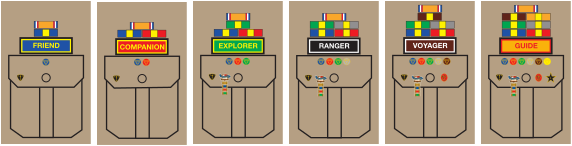
- The Level Chevrons are worn starting 1/2" below the Pathfinder World. As levels are earned, prior levels are moved down, so the highest level is on top. Do not leave any space between chevrons. Even if a level is skipped, do not leave any space between chevrons.
Right Sleeve
- The Club Name Crest is to be centred 3/4" below the shoulder seam. The crest size is to be 4" wide from point to point.
- The Pathfinder Triangle is to be centred 1/4" below the lowest point of the Club Name Crest.
Right Chest Pocket
- The optional Pathfinder Name Plate is centred just above the right pocket or in the same position on the sash since the sash covers its location on the shirt.

Left Chest Pocket
- The highest Class Level Name Strip is centred above the pocket.
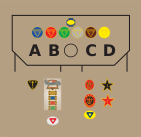
- All earned Level Pins are worn centred across the top of the pocket flap. The highest class pin is to the wearer's left. If a level is skipped, fill in the space with the next highest pin. Do not leave gaps for unearned levels.
- The Advanced Level Ribbon Bars are worn above the Class Level Name Strip and centred over the button. Bars are arranged as shown. Even if a level is skipped, no space should be left for unearned bars.
- The Unit Leadership Plates denoting the captain or scribe are placed on the centre of the pocket.
Pocket Flap Location
There are four designated locations for other pins on the pocket flap. Two on the left side of the button and two on the right side of the button. They are identified as locations A, B, C, and D. Only one pin may be worn in each position at a given time. Normally, the "highest" level pin (typically the most recently earned) is worn.
- Position A - Baptismal Pin
- Position B - Pathfinder Bible Experience Pin or Pathfinder Leadership Award (PLA) Pin
- Position C - Teen Leadership Training (TLT) Pin, Master TLT Pin, or Pathfinder Instructor Award (PIA) Pin.
- Position D - TLT Level Pin or the Staff Service Star.